Friday, 28 September 2012

C’est fini

The last day of class didn’t want to give us the expected picture and our plasmidic extraction ended up being RNA or who knows what. I’m going to get those protocols working for real very soon, oh! I wish I had received the reagents a month ago. But, we are where we are and we have what we have, so, that’s what we start with.
I would be happier if the PCR and the cloning had had a better ending, but still, I think we have had a success here. The students say so, at least. It seems that we helped them understanding a few concepts, opening their minds to the tiny world of molecules, and seeing themselves doing these things on their own. I will be glad to see any of them applying the knowledge they have gained here.
After the IBRO School and this MolBio Course, this introvert that writes needs serious solitude treatment, but I have to admit that I will miss coming into a lab full of people willing to learn. I will especially miss the women, we don’t have many around here in KIU. I wish all the students the best of lucks. I hope the experience was worth the effort of coming all the way to Ishaka. You have now a place that you can call home in Western East Africa.
Safe travels and see you somewhere on planet Earth sometime in the near or far future.

Thursday, 27 September 2012

Anything so that you learn!

I was having a very easy week. My guest Dr. Stella Carlomagno has taken the load of lectures since Tuesday reviewing the basics, making the connection with the clinics and providing plenty of visual media for all of us to understand the core processes of molecular biology (I think I finally understood replication!). Smooth an easy for me, as I was saying, I even had time to interact with some KIU students and give them a hand (and more work, hehe).
Mornings with our Italian doctor, and afternoons in the lab. We purified the digested pSG5 vector and the insert, my old friend the alpha-actinin minigene. We put them both in the presence of ligase to try to get them to stick together again. We transformed E.coli using a new protocol and a not so optimal medium (did I say getting reagents in this country is Indiana Jones’ job? There was no tryptone or yeast extract to be found, so we had to improvise and filter the agar off of some XLD). We innoculated some colonies today, but after 12 hours of power cut, they weren’t the happiest colonies ever, so we’ll see.
We also played a bit with some sequences. We managed to get our gene of interest on NCBI and found the genomic and RNA sequences. We also compared them with Blast, and saw how the non-coding regions are left out. We created a sequence file on ApE and learned how to find and highlight the primer sequences, digest and calculate sizes. We also opened an old chromatogram and saw how those things look when everything is alright, and how when it’s not so alright.
But we have been struggling the whole week to understand why are we seeing two bands (actually, three) when we run an electrophoresis of the alpha-actinin minigene in pSG5 digested with EcoRI and BamHI. Yes, there are two big bands, one of around 4Kb, another one of around 2.4KB. The small one we better leave it out at the moment. Vector and insert, vector and insert, vector and insert… But the vector is a plasmid and, the insert, what is the insert? Well, the insert is a PCR fragment resulting from using the ACTMG primers, those that we were geting on ApE yesterday, on a genomic DNA extraction from Drosophila. I could see their faces. No matter how many times they nodded, there was something that just didn’t make sense.
Today, though, the PCR has failed to give me the tangible element to show them the comparison between the digestion of the vector with the alpha-actinin minigene inserted and the PCR using primers that anneal on the vector and amplify the insert. And I had to improvise. The result, in the video, edited to reduce the gaps due to obvious improvisation matters. Thanks Raquel for those colorful wires.
IMG_0111
1Kb ladder – pSG5alpha-actinin digested with EcoRI and BamHI – actinin PCR (you can see I didn’t forget to add the template DNA, but no luck with the amplification) – clear negative PCR with Rp49 primers on Drosophila genomic DNA

Monday, 24 September 2012

Things don’t always work

Well, we managed to do quite a few things today. We run several PCR reactions with the sample of chromosomal DNA from Drosophila that showed positive on the previous gel. We worked a bit trying to get sequences and design and analyse primers. We poured a gel while we set up some digestions and we finally run everything to see that none of the PCRs worked Triste but that the DNAs from my PhD are still “alive”. We also had time to go over the recombinant DNA techniques once more, with an overview of the cloning process that we are pursuing this week, and we also got an introduction to gene expression regulation without getting into the details of the zillion processes that are involved.
Running the gel with 9V batteries takes quite a while and I stayed late to let the fragments separate well before cutting. It wasn’t the cleanest of digestions, but at least one of the reactions gave us something to work with. We will purify it tomorrow, for now, it will sleep at 4ÂșC.
IMAG0104
On the left, a faint 1Kb ladder indicates that the fragments of the first lane are ok. I cut the vector (upper band) and the insert (lower band) to continue the cloning exercise tomorrow.
IMAG0105
Here you can see the whole left after cutting the lower band.

Friday, 21 September 2012

Just enough

We run the gel with a set of 9V batteries (the power source blew up two weeks ago). After so long, it takes a while to find the patience to remember how difficult it is at the beginning to load anything in those little submerged almost-invisible wells. But we found our way. Everybody loaded at least one sample. They will load more next week. This is just the beginning. Not too bright, hehe, but we got at least a couple of samples of genomic DNA from Drosophila that we can use for PCR on Monday.
IMG_0069
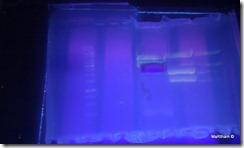
DNA visualized with GRGreen on a PhotoDyne UV box through an empty box of gloves to increase darkness.
Have a nice weekend!!!
PS: Even though I thought there might be enough DNA in that sample, not too well resuspended, I am afraid the big chunck of it was just RNA, which is clearly visible on the gel.

The end of the week

We have talked about the big stars of recombinant DNA technology this morning, restriction enzymes and PCR, and now the students are going to run an agarose gel to see if they extracted any DNA at all these past days (wanna bet?)
IMAG0091                       IMAG0092
Ready, steady, go!

Thursday, 20 September 2012

Still here

While group “One” finished up precipitating the DNA extracted from blood and garlic, the group “Two” got an extra out of the course being introduced to the wonders of little Drosophila. In the short half an hour that we had, they were able to see, inspite all the autofluorescence, neurons in a larvae expressing GFP, live! They also received a short introduction on how to identify male and female flies.
As the day is going, I am afraid is going to be a full day in the lab again. Lectures will have to wait until tomorrow. It takes a while to get used to label the next tube while we are waiting for the centrifuge to finish, to look for the solution we are going to need next before it’s time to pippet, to steal those golden minutes that make simple protocols long and tedious.
As I said before, we are learning! We have been practising how to use both hands at the same time, how to open and close 1.5ml tubes with the left hand, how to use the little finger of the pippeting hand to keep the caps from touching any surface… We are learning, indeed, and this is like running a bicycle, a matter of practice. Let’s hope that we will soon get the funds to start applying all the things that we are learning in our every day research.
IMAG0089
Shake it!
Now, I am puzzled by something that is happening with this blog: when I look at the stats, most of the visits are registered from Sweden. I am pretty sure it’s not real so, who is using a Swedish vpn to read us?

Wednesday, 19 September 2012

Slowly, but we are pippeting

Again I am destroyed, just an excuse to be brief, again. We have spent the whole day in the lab. In the morning, we had to finish preparing the buffers and solutions needed and, in the afternoon, we had to start using them. It took much longer than expected, though, which is just the expected. We are all learning here.
Tomorrow we have to repeat this afternoon’s session switching the groups. We have decided to start with the lab in the morning to see if we can leave school before going 12 hours around the clock since we arrived. Let’s see if the second day in the lab things move a bit faster and we get to do at least a short lecture on recombinant DNA tools. We will leave the heavier lecture on gene expression regulation for Friday hoping that we will be more open to the concepts.
This is fun. Exhausting, but fun CaracolTortugaCaracol